Balochistan’s first STEAM lab
SIA set up a STEAM & Robotics Lab at Government Sandeman Higher Secondary School in Quetta, the first STEAM lab in the province.
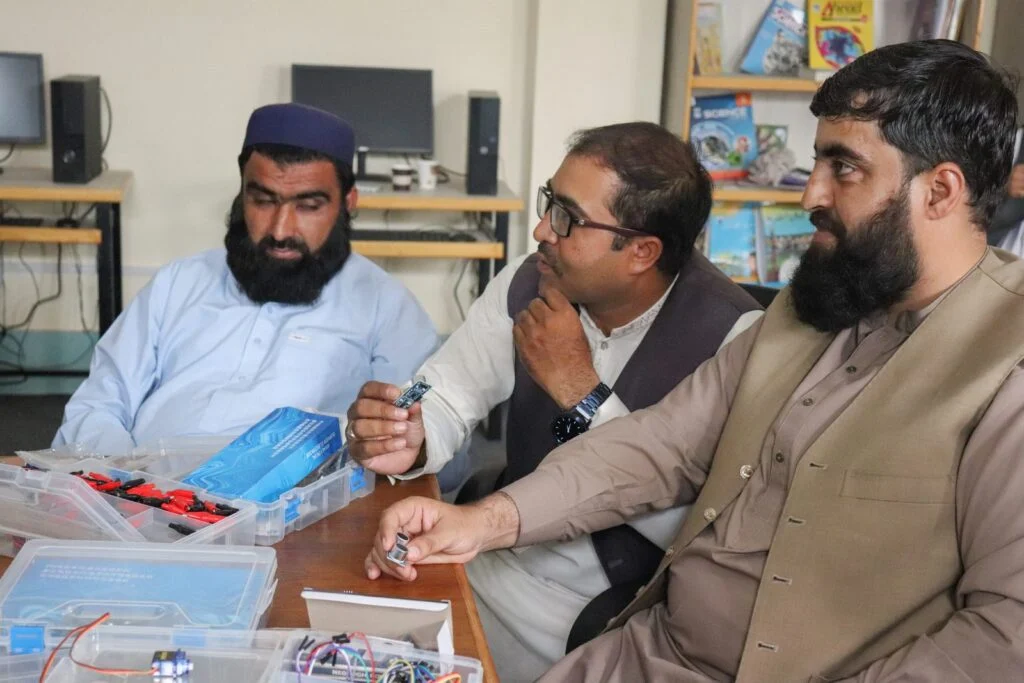
SIA set up the first STEAM lab in Balochistan: a STEAM & Robotics Lab at Government Sandeman Higher Secondary School in Quetta. The lab was featured by the Pakistan-U.S. Alumni Network (PUAN) in 2025, and PUAN’s November 2025 newsletter recognised the SIA co-founders behind it.
What STEAM means
STEAM stands for science, technology, engineering, arts and mathematics. A STEAM lab is a room where students learn those subjects by building things: they design, test, fail, fix and try again, often in teams. Adding the arts to STEM matters, because design, storytelling and making things that people want to use are part of solving real problems.
In a robotics lab, students typically start with simple circuits and sensors, then build and program small machines that respond to the world around them. The goal is less about robots and more about habits: breaking a big problem into small steps, testing ideas quickly and explaining your work to others.
Why it matters in Balochistan
Many schools in the province have little hands-on science equipment, and students outside the largest cities rarely get to use it. A lab in Quetta gives students a place to practise, and gives teachers a model they can adapt with modest equipment. It also connects with the rest of SIA’s work: the same problem-solving that drives a robotics project drives a student’s first business idea in a Changemaker School.
Bootcamps and teachers
Besides the lab, SIA runs STEM and robotics bootcamps for students and works with teachers, so the approach outlasts a single event. In 2024 and 2025 the bootcamps covered robotics, AI, coding and 3D printing, and government teachers were trained in STEM methodology.
Bring STEAM to your school
School leaders, teachers and organisations who want a lab or a bootcamp can contact SIA on WhatsApp or through the contact page.
Photos of students are published only with written consent.
What students take away
The most lasting results of hands-on learning are habits rather than facts: working in a team, sticking with a problem when the first attempt fails, and explaining an idea to people who disagree. Those habits matter whether a student becomes an engineer, a teacher or the founder of a business in their own town.
A STEAM corner on a small budget
A full lab is not the only way to start. Teachers can set up a simple STEAM corner with low-cost materials:
- Cardboard, tape, string and recycled bottles for building and testing structures
- Basic circuits with batteries, wires, small bulbs and motors
- A notebook for each team to record what they tried and what happened
- One real local problem each term, such as keeping a classroom cool, for students to work on
What matters most is the habit of trying, testing and improving, and a teacher who asks good questions instead of giving the answer straight away.
Update, October 2026: under SIA’s Strategic Plan 2026–2031 the lab sits in the Academy, under STEM & STEAM Labs, next to Changemaker Schools, which aims to reach 500 schools by 2031. School leaders can register interest on those pages, and funders can start on Partner With Us.